
Why Competitive Intelligence Breaks Before It Reaches Action

Most organisations believe they have a competitive intelligence problem.
In reality, they have a competitive intelligence flow problem.
In large, asset-heavy businesses — FMCG, pharma, manufacturing, chemicals, retail — competitive data already exists in abundance. Sales teams see competitor discounts in the field. Marketing tracks promotions and messaging shifts. Supply-chain teams notice changes in stocking patterns and lead times. Strategy and finance teams monitor market share, margins, and capacity announcements.
The problem is not that this data is missing. The problem is that it never comes together.
Competitive intelligence doesn’t fail because companies don’t track competitors.
It fails because signals break down between tracking and action.
Fragmentation, not shortage, is the root cause
Competitive signals are usually scattered across functions:
Sales sees price pressure, distributor behaviour, field feedback
Marketing sees campaign intensity, messaging shifts, promotions
Operations sees capacity changes, lead-time movements, supply responses
Finance & strategy see margin trends, market share, long-term bets
Each function holds a partial truth.
Very few organisations have a mechanism to synthesise these partial truths into a coherent view.
As a result, teams are busy tracking competitors — yet leadership is still surprised when a competitor makes a decisive move. Not because the signal wasn’t visible, but because no one connected it end-to-end.
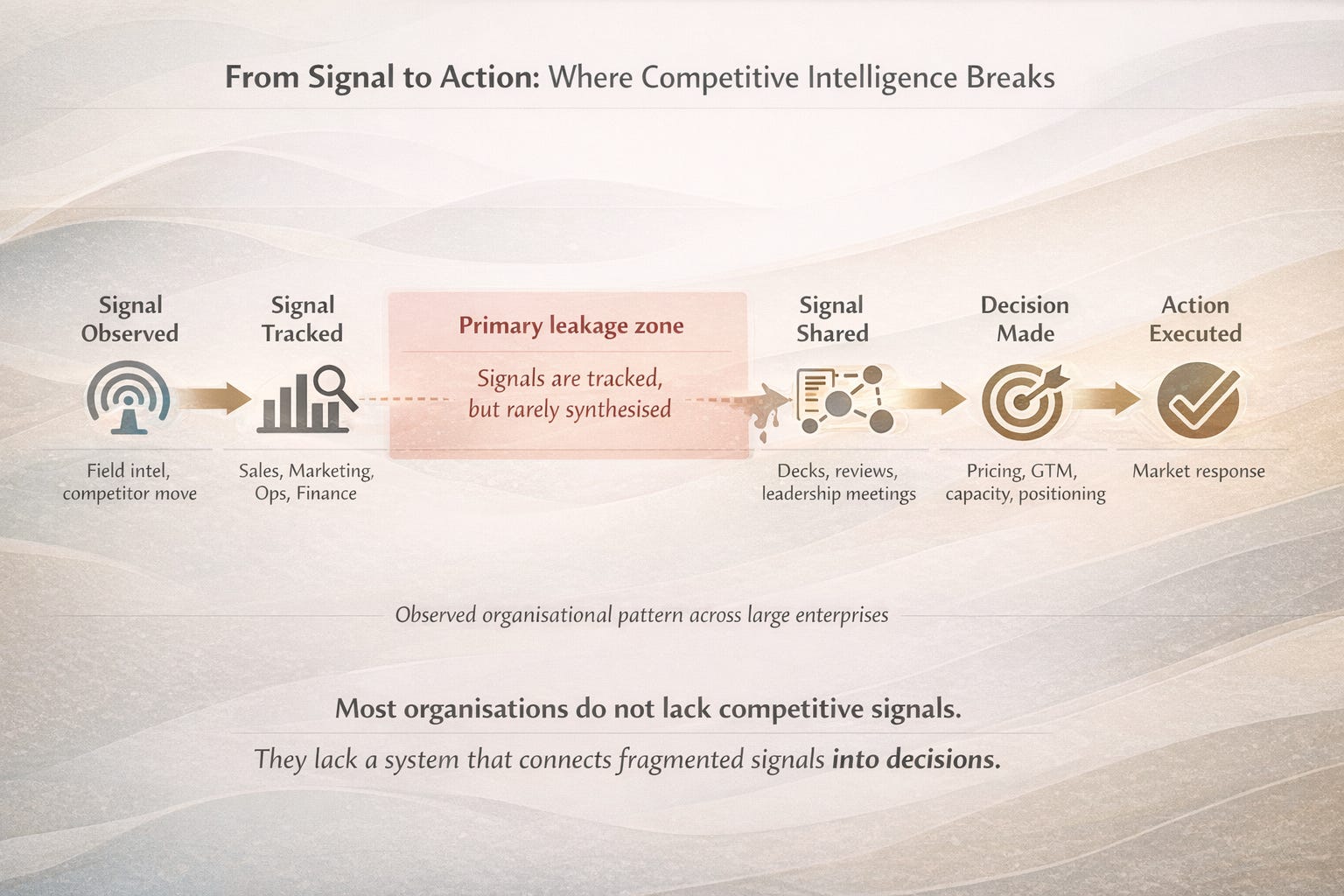
Most competitive signals pass through the same stages:
A signal is observed
It is tracked within a function
It is shared in a meeting or deck
It should be synthesised across functions
A decision should follow
Action should reach the market
In practice, most signals die between tracking and synthesis.
They are collected diligently, discussed briefly, and then forgotten.
Meeting decks get archived. Field insights stay with the sales team. Strategy updates remain theoretical.
This is not negligence.It is a design flaw.
Competitive intelligence is treated as a by-product of functional work — not as a system with ownership, flow, and decision thresholds.
Meetings consume data, but don’t institutionalise it
One of the most under-appreciated CI failure modes sits inside meetings.
Organisations are good at pulling data into decks. They are far worse at ensuring that the information discussed survives beyond the meeting itself. Organisational research consistently shows that a large share of information reviewed in leadership forums is never institutionalised into ongoing decision processes.
This creates a dangerous illusion:
Data appears to be “used”
But no mechanism exists to track what changed as a result
No signal ownership carries forward
No hypothesis is recorded
No feedback loop closes
Competitive intelligence becomes episodic, not cumulative
The cost of fragmented intelligence
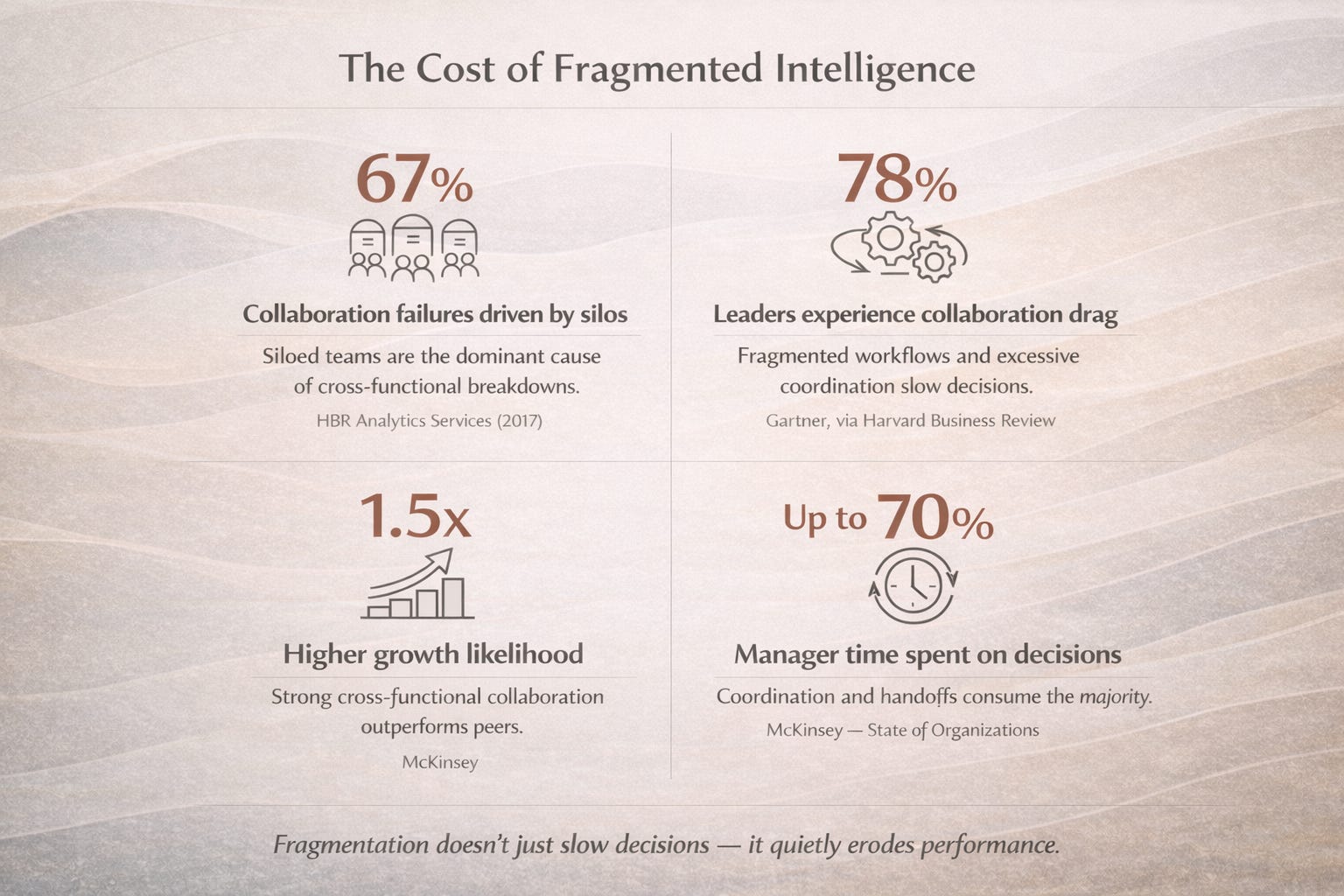
Fragmentation is not just inefficient — it is expensive.
Research across large organisations shows that:
A majority of collaboration failures are driven by silos
Leaders experience significant “collaboration drag” due to fragmented workflows
Cross-functional collaboration correlates strongly with higher growth outcomes
Managers spend a disproportionate share of their time on decisions — much of it lost to coordination rather than insight
These findings don’t come from CI studies specifically.
They come from organisational effectiveness research — which is exactly the point.
Competitive intelligence fails not because it is unique, but because it is subject to the same silo dynamics that hurt decision-making everywhere else.
Why physical-product businesses are especially exposed
In physical, asset-heavy industries, this fragmentation is amplified.
These organisations are structurally complex:
Multiple product lines
Layered distribution networks
Regional variations
Longer planning cycles
Data is naturally decentralised. And while many firms have invested heavily in analytics and reporting, integration across functions often lags.
This is not a technology critique.It is an organisational one.
Most companies do not fail because they lack dashboards.They fail because they lack a coherent intelligence operating model.
The real insight
Most organisations don’t need more competitive data.
They need better signal flow.
Before asking what to track, leaders need to ask:
Where does competitive intelligence live?
Who owns synthesis, not just collection?
How does a signal move from observation to action?
Until this is addressed, improvements in tracking — more reports, more reviews, more tools — will only increase noise.Competitive intelligence does not fail at the edges.
It fails in the middle.
What’s next in this series
This article focused on why CI breaks before it reaches action.
In the next part, we’ll look at a related but distinct failure mode:
why tracking more competitors often makes decisions worse, not better — and how organisations can regain focus without losing awareness
Series note
This article is part of Seeing Competitors Clearly — a series on how competitive intelligence actually works in practice, beyond dashboards and theory.